
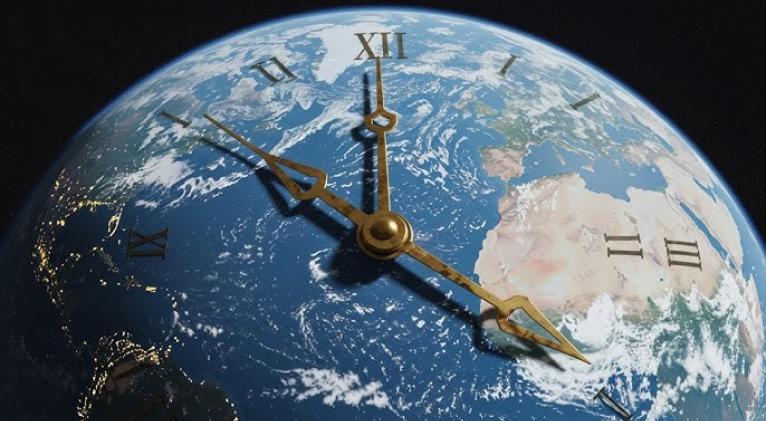
This July 22 will happen. The Earth will complete a complete rotation in a slightly lower time than usual. Therefore, it will be the shortest day on earth ever registered.
The difference will be only 1.34 milliseconds less than the standard 24 hours. But it is part of a strange trend in the rotational behavior of the earth that has been developing in recent years. If it continues, it may be necessary to subtract a second from atomic watches around 2029. It is called the second negative intelar, and something never seen before, according to Space.com.
Tides and days
Earth's rotation speed is not fixed. A long time ago, one day was much shorter than 24 hours (or 86,400 seconds) to which we are accustomed. One day on earth it lasted approximately 19 hours for much of its early history. It was due to the balance between the solar atmospheric tides and the lunar ocean tides. But over time, one day on earth it has become consistently longer. The main culprit has been the friction of lunar tides, which has gradually removed it from the earth. As it moves away, the moon absorbs the rotational energy of the Earth. I slow down its rotation and lengthens the days.
The records began (with the invention of the atomic clock) in 1973. And until 2020, the shortest day ever registered was 1.05 milliseconds less than 24 hours, according to Timeanddate.com. But since 2020, the earth has repeatedly beaten its own speed records. The shortest day ever measured on July 5, 2024. The rotation of the Earth was completed 1.66 milliseconds faster than usual.

New records
Facing 2025, scientists predicted that July 9 and 22 and August 5 could be the shortest days of the year. However, new data suggests that July 10 became the shortest day to date in 2025, with 1.36 milliseconds less than 24 hours. It is expected that on July 22, the Earth completes its turn 1.34 milliseconds before. This continues with the competition to define what is the shortest day on earth.
- 0
- 0
- 0
- 0
- 0
- 0
Leave a Reply