
The research belongs to astronomers from the University of Durham (United Kingdom). Help explain an ancient mystery about the galaxy. The Milky Way could have undergone a notable change in its orientation throughout its history. The research is presented at the Royal Astronomical Society's National Astronomy Meeting in Birmingham, UK. And it explains the drastic turn of the Milky Way.
Supercomputer simulations were made of galaxies such as the Milky Way. Galaxies with slowly rotating stellar halos were found to be more likely to have undergone a major "disk spin." The galaxy's disk was able to change its orientation by more than 90 degrees.

stellar halo
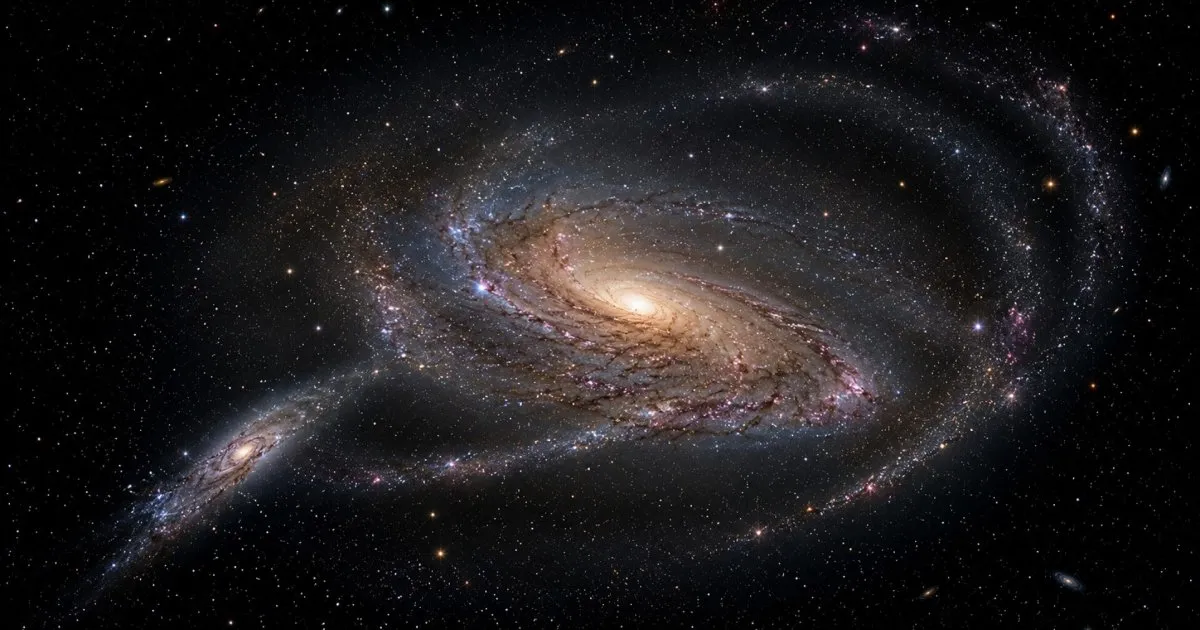
Most of the stars in the Milky Way are located in its flat spiral disk. Surrounding it is a much larger but much less dense stellar halo. They are stars that originally formed in smaller galaxies before being attracted to the Milky Way through galactic mergers.
Observations from the European Space Agency's Gaia mission show this. The Milky Way's stellar halo rotates very slowly. It is not known why. The evolution of 25 galaxies similar to the Milky Way was analyzed. They found that galaxies with slower-rotating stellar halos shared two important characteristics. They had a major frontal merger with another galaxy. And they suffered a disk inversion during their evolution.
"We already know that the Milky Way had a massive head-on collision in the past. It was with a galaxy known as Gaia-Sausage-Enceladus. Therefore, we believe that the Milky Way disk was probably inverted in the past," they explain.
The Gaia-Sausage-Enceladus galaxy was a huge dwarf galaxy. It collided with and was absorbed by the early Milky Way between 10 and 11 billion years ago. This decisive galactic merger was the largest event in the early history of the Milky Way. It reshaped our galaxy, leaving billions of stars orbiting in very elongated, sausage-shaped trajectories.
Testing ground
The drastic rotation of the Milky Way would explain this phenomenon. It is our best laboratory to study the evolution of galaxies and dark matter. A disk change does not occur in all galaxies. So it offers astronomers clues about how similar galaxies formed. "Because we live inside the Milky Way, we can study it in more detail than any other galaxy. It is a key test bed for understanding galaxies in general," they add.
Leave a Reply