
Let's think about a broad definition of the term “vision.” It is the ability to capture light from the environment, transform it into biological signals and interpret it. It helps us to represent the world around us in a useful way. Seen this way, one could understand the way plants see.
They are photosynthetic organisms. Plants are capable of absorbing and using light with extraordinary sophistication and efficiency. But, for them, light is not only the energy that fuels photosynthesis, it is also information. Light is a first-order environmental signal about the day-night alternation. Warns if they are surrounded by competitors, when they should germinate, or flower.
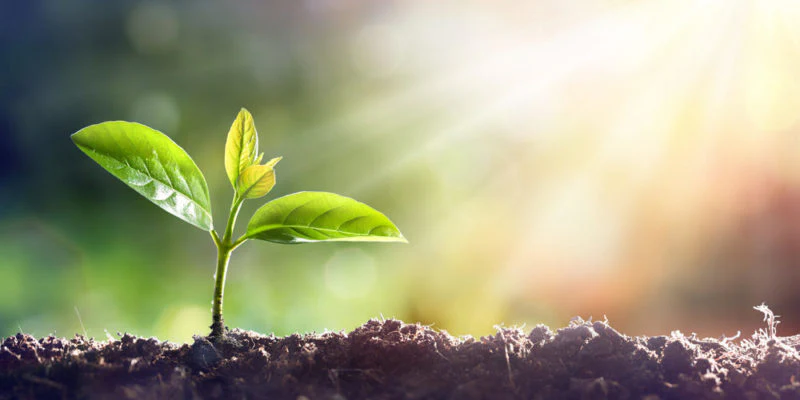
reading the light
The key to this perception is in the photoreceptors. They are biomolecules that function as sensors capable of absorbing light and transforming that physical information into biological responses. Plants have photoreceptors specialized in interpreting light information associated with discrete ranges of electromagnetic radiation. They are able to interpret its spectral quality, that is, they “perceive colors.”
Phytochromes, a large family of photoreceptors, are among the best characterized. They are proteins linked to a kind of “antenna” (chromophore) capable of absorbing photons in the red and far red areas. It is a reversible switch that informs the plant about the spectral quality of the light around it.
One of the most fascinating aspects is that plants can detect their neighbors based on the degree of shading using phytochromes as sensors. They achieve this by measuring the ratio between red light and far red light. Direct sunlight contains both. But leaves absorb a lot of red light for photosynthesis and let through or reflect more far-red light.
The plant changes its architecture: it lengthens stems, modifies the orientation of its leaves and reduces branching. You are not “thinking,” but you are making developmental decisions. Its body reorganizes itself to reach the light sooner or better than its competitors. This ability has enormous agricultural implications. In a dense crop, for example, plants invest too much energy competing for light instead of producing seeds. It helps us select varieties that are more tolerant to shade. They are capable of growing at high density without excessively activating escape responses.

Regulate calendars
The way plants see influences the entire cycle. Light through photoreceptors regulates the internal calendar of many species. Thanks to this, some species flower when the days get longer, others when they get shorter. In this way, they adjust their life cycle to the most favorable season. Flowering is a key moment in its life cycle. Its success depends, to a large extent, on correctly interpreting which environmental conditions are the most favorable.
Leave a Reply