
Acadia University in Canada explores the effects of rising ocean CO2 levels on the neurology of squid. Their results were presented at the Society for Experimental Biology conference in Florence, Italy. It reveals that the squid are reduced in size and their brain volume could decrease by approximately 50%.
This severe brain reduction is most pronounced in the areas that interpret visual information. It correlates with significant reductions in normal eating behaviors. And it suggests serious consequences for the future of squid and other cephalopods.
At the brain level
"Cephalopods are considered one of the most intelligent groups of animals that live in the ocean," they indicate. The subclass Coleoidea, which includes squid, cuttlefish and octopuses, are the most intelligent invertebrates on Earth. They have a number of neurons similar to that of dogs.
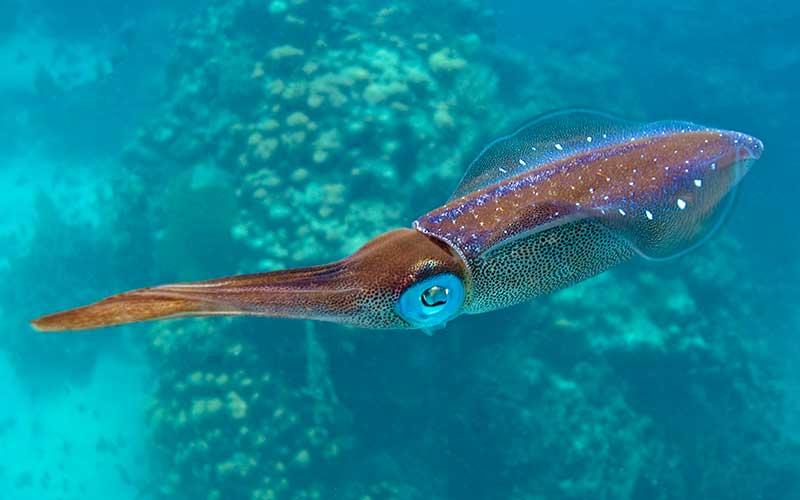
Ocean acidification is caused by the high level of atmospheric CO2. It is a serious threat to many marine species. This project reveals a previously unknown impact on cephalopod neural anatomy. The largefin reef squid, Sepioteuthis lessoniana, reared from hatching in elevated levels of dissolved CO2, exhibited significant changes in brain physiology. The most striking was a 49% reduction in brain volume.
Squid were raised in two parallel water tanks. One that represented the current oceans (pH 8.2). Another that represented the oceans in the year 2100 (pH 7.8). After 90 days, the squid were removed and their heads were retained for analysis. This confirmed that squid reduce in size, but only at the brain level. There was no effect of CO2 on total body size. The greatest reductions were found in regions identified as the optic lobes and optic tracts.

Little activity
It was revealed that a 7-day acute exposure to high levels of CO2 resulted in a 65% reduction in hunting behaviors. Squid exposed for 90 days showed a 42% reduction in hunting behaviors.
Quickly interpreting visual information is vitally important for largefin reef squid. It relies on its eyesight to track and capture its prey. "We believe that the reduced willingness to feed could be related to a decrease in visual acuity," they declare. "Not because of the retina itself, which seems to stay the same. But perhaps because the optic lobe is shrinking.
This is due to energy limitations within the brain or oxidative damage. It could mean that the brain is unable to transmit information correctly and lead to the abnormal eating behavior the team has observed.
Leave a Reply