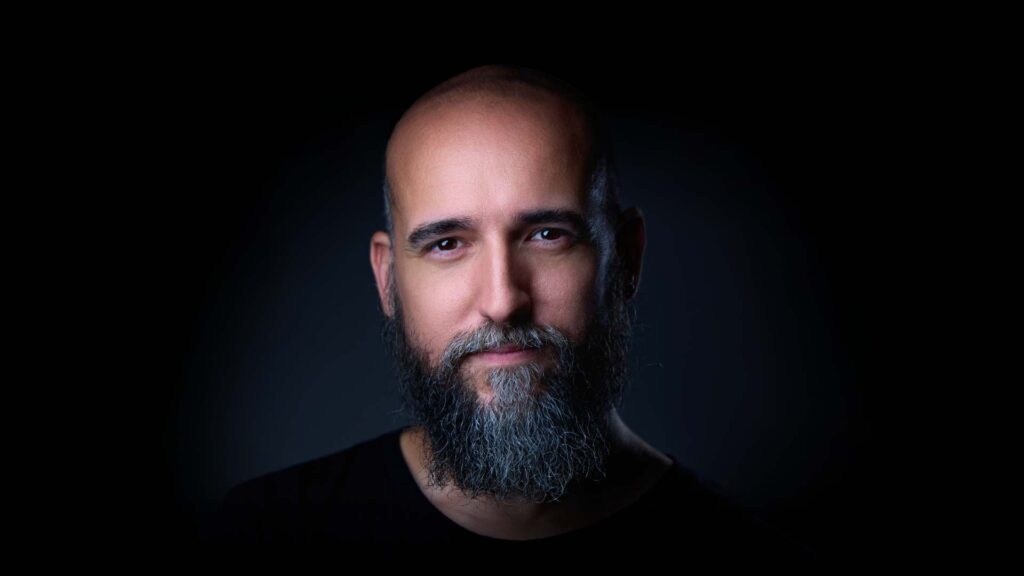
INTERVIEW with Jon Hernández, popularizer of Artificial Intelligence who has just published his first book, “The coming host"(Editorial Planeta). He assures that the revolution has already begun and not participating in it as soon as possible can lead to regret. "You still have time, but you shouldn't fall asleep," he assures.
– Jon, the title of the book already warns us, but… are we prepared for “The Coming Host”? You mention it in the future, but... is it already here and we don't realize it?
No, we are not prepared. And that is precisely the problem. Most people still think that AI is something that will arrive in a few years, as if we were still in the movie trailer, but no: the movie has already started.
HostIA is not something of the future. It's already here, it's just that many people have not yet understood the scale of the change. It is already affecting work, education, medicine, creativity, the way we inform ourselves and even how we distinguish what is real from what is false.
What happens is that we continue living as if this were just another tool, as if it were another technological advance like the internet or the smartphone. And I think it's much deeper than that. AI is not about to change a specific application or industry. It comes to change the entire game.
– How will AI impact – or rather, how is it already impacting – our lives, our jobs, our way of relating...? Are we aware of what it entails?
It is impacting everything, although not always visibly. At work, it now allows tasks that previously required hours to be done in minutes. Preparing reports, summarizing meetings, responding to emails, creating presentations, analyzing data, programming, writing, designing, researching… all of that is already changing.
But it doesn't stop there. In education, it leads us towards a model where each child can have a personalized tutor. In medicine, it can accelerate diagnosis, research and development of treatments. In our relationships, it will also have a huge impact, because we will begin to link with systems that seem to understand us, listen to us and accompany us.
Are we aware? In general, no. We are seeing small loose pieces, but not the whole picture. And the complete picture is that intelligence, which until now was our great differential value as humans, is beginning to be produced by machines.
– There are those who still think that AI is something for “technology enthusiasts” or for programmers and developers. What would you say to those people who believe that AI still has nothing to do with their daily lives?
I would tell you that that is one of the most dangerous mistakes you can make right now. AI is not for programmers. AI is for anyone who works with information, with decisions, with clients, with documents, with emails, with ideas or with processes. And almost everyone works with one of those things.
You don't need to know how to program. You don't need to be technical. In fact, the powerful thing about this revolution is that it works with natural language. You talk to him like you would talk to a person.
That is why it will enter all sectors, from a law firm to a clinic, a production company, a plumbing company or a sales department.
Anyone who thinks this doesn't suit them will probably realize it too late. And by the time you realize it, others will have already gained a lot of advantage.
-What is the greatest benefit that AI brings today?
The biggest immediate benefit is productivity. AI allows us to do much more, better and in less time. And that, used well, is outrageous. On a personal level it can free up hours each week.
At the business level it can make small teams produce like huge teams. And on a social level it can improve medicine, education, scientific research and many other fields.
-And the greatest risk or danger?
The greatest immediate risk is twofold: on the one hand, the manipulation of the truth; on the other, employment. We can no longer trust an image, audio or video in the same way, because anyone can create something fake that looks real. And at work we are moving towards a scenario where many tasks that were done by people can be done by an AI or a human using AI.
Then there is a more fundamental risk, more difficult to manage, which is creating systems that are increasingly more autonomous, more intelligent and less understandable for us. There we enter an area where it is advisable to have a lot of humility.
– What AI applications do you consider most promising?
The most promising are very clear: medicine, science, education and productivity. In medicine, AI can help detect diseases earlier, process thousands of scientific studies that no doctor can read alone, and accelerate drug discovery.
In science, it can solve problems that have been blocked for decades. In education, you can personalize learning in ways that previously only a privileged few could afford. And in productivity, it can make anyone much more capable in their daily lives.
– And which are the most worrying from an ethical perspective?
The most worrying are those that affect truth, manipulation and autonomy. Deepfakes, voice cloning, fake images, scams, political manipulation, emotional dependence on artificial systems or delegating too much thinking to machines.
I am also very concerned about what happens when an AI starts making decisions or acting as an agent without us fully understanding why it does what it does. AI is not good or bad by itself. The problem is what we use it for, who controls it and what incentives are behind it.
– Which sectors or professions are most at risk of disappearing or being radically transformed by the impact of AI?
The most exposed professions are all those based on repeatable cognitive work: administration, customer service, marketing, programming, consulting, financial analysis, legal, human resources, design, content, support, documentary research... In general, any office job where an important part is reading, writing, summarizing, analyzing or making decisions with information.
But be careful, because this does not necessarily mean that entire professions disappear overnight. Many times what will disappear will be the need for so many people doing those tasks. That is to say, there may still be lawyers, marketers or programmers, but they will be needed less if each one produces much more with AI.
And let's not think that manual trades are completely out. It will take longer, but with robotics and automation changes will also come there. Even a plumber or electrician can use AI for estimating, customer service, organization, sales, or diagnosis.
– How will AI have transformed the world in 5 years?
Honestly, making five-year predictions with AI is almost reckless, because this moves too fast. But I do believe that in five years AI will be fully integrated into our daily lives. It will not be something that you “use” from time to time, but something that will be in the mail, in the mobile phone, in the car, in companies, in schools, in hospitals and in almost any digital tool.
I also think we will see enormous pressure on the labor market. Especially in junior profiles and office jobs. Many companies will not hire the same as before, because before hiring a person they will ask themselves if this can be done by an AI or someone on the team with AI.
In education we will see much more personalized models. In medicine, advances that would seem like science fiction to us right now. And in information we will experience a quite serious crisis, because distinguishing what is true and what is not will be increasingly complicated.
– What would you recommend to someone who wants to start using AI in their work or personal life today?
I would tell you to stop testing AI as if it were a toy and start putting it into real processes. It's not enough to ask ChatGPT four curious questions and say, “Well, okay.”
No. You have to apply it to specific things. Start with what takes up the most time: emails, meetings, reports, preparation of documents, search for information, planning, analysis, ideas, presentations. Take one task you do every week and ask yourself, “How could I do this with AI?”
That's where the change begins. I also recommend paying for a good tool, even if it's a basic subscription. It is much more expensive not to use it than to pay for it, because what is at stake is your time and your competitiveness.
– As a trainer and disseminator, what mistakes do people make the most when they try to understand and get more out of AI?
The first mistake is to think that this is about magical prompts. People look for “the definitive prompt”, when that is not what is important. The important thing is to understand how to integrate AI into the way you work.
The second mistake is to use it once, get a mediocre response, and conclude that “it doesn't work.” Usually the problem is not the AI, but how you are using it, what context you give it, what you ask of it and how you iterate.
The third is to go to extremes. Or think that AI is going to solve everything, or think that it is overrated nonsense. Both positions seem wrong to me. You have to be pragmatic: take advantage of what already works and be very careful with the risks.
And the fourth mistake is not touching it. That's the worst. Because this is not understood by reading headlines; it is understood using it.
– What advice would you give to someone who is now starting to become interested in AI? Are you late or still in time to take advantage of the AI wave?
There's still time, but he shouldn't fall asleep. It's not late, but it's not in 2022 either. The window of advantage is still open, but it's closing fast.
My advice would be: train yourself, try, make mistakes, use it every week and make it part of your work. You don't have to become a machine learning engineer. You need to be fluent in using AI, just as today we take for granted that someone knows how to use the internet, Excel or email.
Before long, saying “I don't use AI” will sound similar to saying “I don't use the Internet.” And that, professionally, can leave you out of your game.
– Is there no one to save us from the coming host?
I don't think anyone will come to save us from outside. There will be no magic red button, no perfect global pause, no simple political solution that will fix all of this at once. AI is already here and there is no one to put it back in the box. But that doesn't mean we're doomed. It means you have to wake up.
As a society, we need to understand it, regulate where it makes sense, educate people and reduce harm. And as individuals, we have to adapt, learn to use it, and help others do the same.
The host is coming, yes. Or rather: it is already here. The question is not if it will affect us, because it will surely affect us. The question is whether it will catch us looking away or with our eyes open, prepared to navigate it as best as possible.
Leave a Reply