
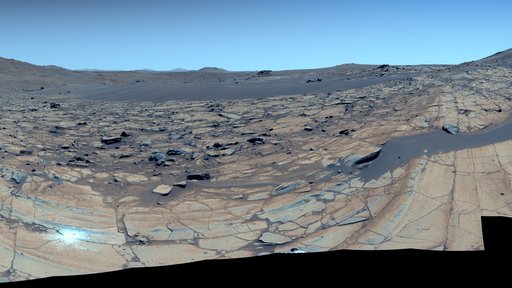
It was captured by the NASA Perseverance Rover Image team. He took advantage of Mars's clear skies to capture one of the most clear panoramic views of his mission to date. The mosaic is made up of 96 images. You can see a rock that seems to lie on a wave of sand, a dividing line between two geological units and hills at a distance of up to 65 kilometers. Mars's shocking morning looks a clear horizon.
Curious rocks
The version with improved colors shows the Martian sky remarkably and deceptively blue. The version with natural colors is reddish. The rover mastcam-z instrument captured the images on May 26. Perseverance reached the top of the edge of the crater at the end of last year.
"The skies relatively free of dust offer a clear view of the surrounding terrain." He declared it in a statement Jim Bell, principal investigator at Arizona State University in Tempe. «And in this particular mosaic, we have improved color contrast. This accentuates the differences between the terrain and the sky ».
Mars's shocking morning shows interesting details. One that caught the attention of the scientific team is a great crook -shaped rock to the right of the center of the mosaic. It is about 4.4 meters from the rover. Geologists call this type of "floating rock." It is very likely that it will be formed elsewhere and was transported to its current location.

Notable details
The bright white circle just to the left of the center and near the bottom of the image is an abrasion zone. This is the number 43 that Perseverance has eroded since it landed on Mars. 5 centimeters wide, this shallow area was created with the Rover drill. It allows the scientific team to see what is under the eroded and dusty surface of the rock.
A little more than half of the mosaic, spreading from one edge to the other, is the transition of rocks with lighter tones to rocks with darker tones. This is the limit line, or contact, between two geological units. The flattest and clearest color rocks closest to rover are rich in the Olivino mineral. It is believed that the darkest rocks are more distant rocks that contain clay.
Leave a Reply