
It is one of the most distant planets in our Solar System. We don't know much about this one yet, but there is something that caught the interest of researchers. It is about the formation of the moons of Uranus. The study was carried out by the California Institute of Technology (Caltech) in the United States.
The institute narrows down the possible origins of Uranus's five regular moons. Uranus's axis of rotation is tilted 98° with respect to the solar system. This is possibly due to an ancient giant impact. That's the first clue. The results are collected in 'Proceedings of the National Academy of Sciences'.
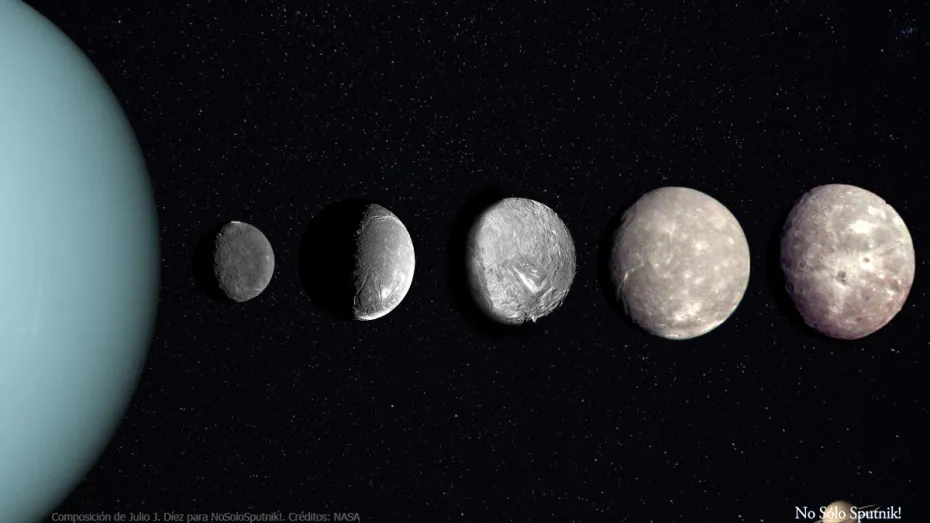
Proportions
The planet's five regular moons orbit on the same inclined plane. However, the origin of their inclined orbits is unclear. Michael Brown and his collaborators used measurements of deuterium-hydrogen (D/H) ratios in the water ice of the five regular moons of Uranus. How did they obtain them? From observations from the James Webb Space Telescope. Thanks to this, lunar formation scenarios could be explored.
The analysis indicated that the average D/H ratio for the five moons was almost five times greater than the D/H ratio measured in the atmosphere of Uranus. This would be comparable to the proportions measured in comets.
The estimated D/H ratios indicate that the moons do not contain substantial amounts of uranian material. This therefore rules out formation scenarios involving significant mixing of the planetary system following a giant impact.
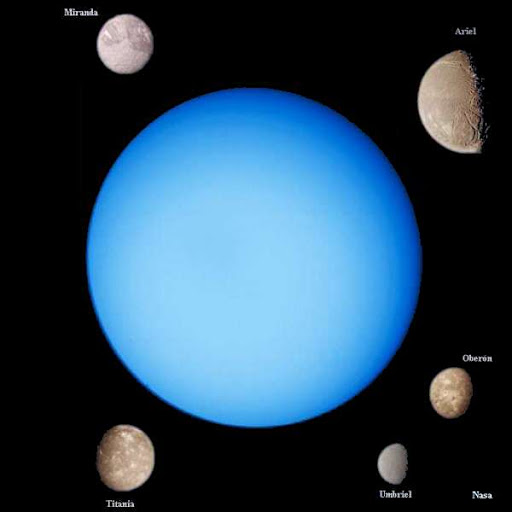
Remains of another system
The analysis suggests that the moons could have formed from the remains of a pre-existing satellite system. This could have been destroyed by a giant impact. Or from bodies in the Outer Solar System captured by the tidal forces of Uranus.
The formation of the moons of Uranus does not have the same history in all five cases. There is a slightly elevated ratio of Miranda, the innermost regular moon compared to the other moons. It could indicate a different formation history. According to the authors, these findings could help elucidate the origin of the moons of Uranus.
Leave a Reply