
It is widely documented in a wide range of the animal kingdom, mainly among vertebrates. Now a remarkable example is added in the world of insects. Insects that use tools
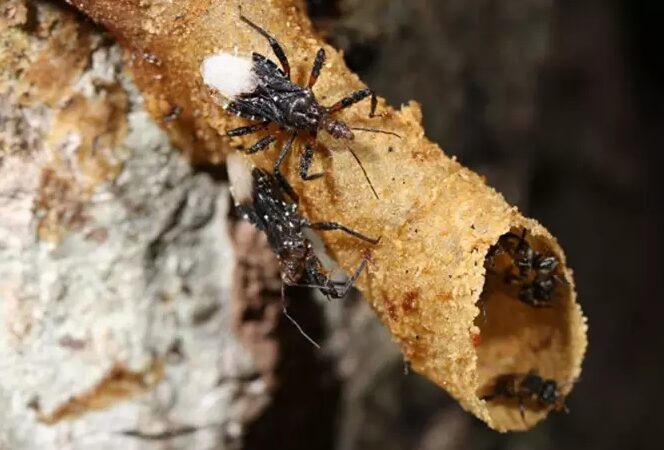
Researchers from the Agricultural University of China and others describe the behavior of the murderous chinche, Pahabangkakia Piliceps (P. Piliceps). Use the spin -free bees nests to attract them to the optimal hunting position of the predator. This is the first complete evidence of this behavior in an invertebrate predator. Use tools to exploit collective defenses of social insects.

Sophisticated strategy
Stingless bees deposit a sticky resin and the entrances of their nests to dissuade intruders. Predators like ants or geckos are trapped. And guardian bees crowded to immobilize them. But the Killer Chinche uses this defensive mechanism against bees.
The researchers observed that the Chinche Killer Deliberately resin with its legs to cover them with the sticky material. The amplified chemical signal of the resin attracts guardian bees towards the location of the murderous chinche. The resin not only does not repel the predator: it acts like a lighthouse, attracting the bees. "It is a sophisticated manipulation of the behavior of the dam." This was said by scientists in a statement. «The bug not only avoids being detected. It also actively causes attacks to create opportunities ».
In controlled field trials, it was shown that resin coatcases were successful 75 % of the time. This rate was reduced to less than 30 % for bed bugs. Apply resin to body parts that do not hunt (for example, the abdomen) also offered a relative benefit. The viscosity of the resin was not the key to predatory success.

Adapting
The bug depends completely on stingless bees for survival and reproduction. This dependence probably promoted the evolution of its unique behavior in the use of tools. They use it to improve its hunting efficiency. There is a link between the use of tools and dietary specialization in the animal kingdom.
This challenges the assumptions that the complex use of tools requires advanced cognition. And highlights how ecological specialization can mold apparently intelligent behaviors. "Unlike vertebrates, these insects offer a practical system to explore the evolution of the use of tools in animals," they said.
Leave a Reply