
What is this? SOME Astronomers FROM Northwestern University (United States) asked him. They found salty skies surrounding a famous planet. The news of the Pink Planet surprise is in The Astronomical Journal'.
For more than a decade, this ancient world shrouded in a pink haze kept astronomers intrigued. The James Webb Telescope (JWST) revealed an atmosphere with exotic chemistry and saline clouds like never before seen. Test the presence of salt clouds in the atmosphere of a cold object. It's a phenomenon that scientists theorized more than 15 years ago.
Getting cold
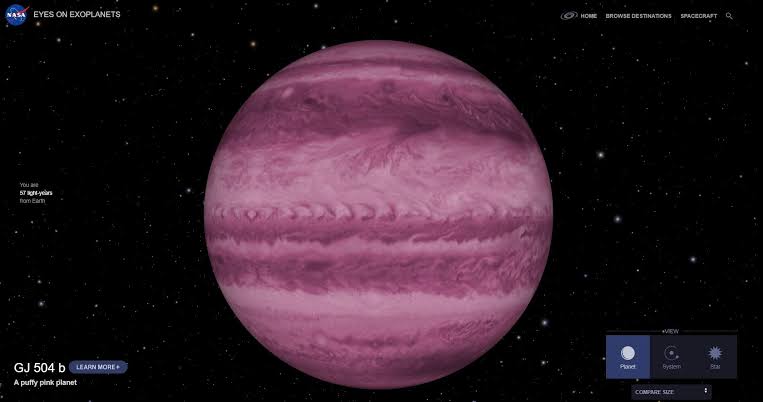
"The Pink Planet is the coldest companion ever discovered with ground-based instruments," the researchers say. "It wasn't like anything we'd ever looked at before." Discovered in 2013, the Pink Planet (known as GJ504b) orbits a Sun-like star, located 57 light years from Earth. Despite its nickname, astronomers are not sure if it is actually a planet. It has a mass 25 times that of Jupiter. It is near the diffuse boundary between giant planets and brown dwarfs. For this reason, astronomers call it a “planetary mass companion.” It is a planet-sized object orbiting a star.
Repeated attempts to study it with ground-based telescopes have been unsuccessful. Most directly observed exoplanets have temperatures close to 1,000 or 2,000 degrees Fahrenheit. But this one is only 550 degrees Fahrenheit (290 degrees Celsius). The temperature of a bread oven.
The age of its companion planet is responsible for its low temperature. Giant planets cool with age. It is estimated to be between 2,500 and 4,000 million years old.
Other cold planets
The surprise of the Pink Planet and its salty skies was confirmed thanks to multiple combined observations. The spectrum also suggests that GJ504b is unusually rich in heavy elements, or metals. However, the mystery of the object's formation persists. Current data indicate that it could have formed as a planet or a small star.
The techniques used in the study could help unravel other mysteries surrounding cold, dim planets. Jupiter, for example, hosts clouds composed of ammonia ice.
Leave a Reply