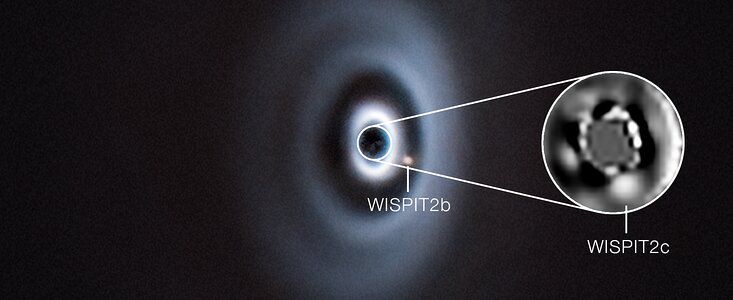
A team of astronomers observed it. There are two planets in the disk around a young star called WISPIT 2. The presence of a planet had previously been detected. Now they used telescopes from the European Southern Observatory (ESO) to confirm the presence of another. Apparently, it is a Solar System in formation.
"WISPIT 2 is the best look at our own past that we have to date," say the researchers. The study was published in The Astrophysical Journal Letters. The system is the second known of its kind, after PDS 70. It is rare to observe two planets around their host star during the formation process.
Powerful telescopes
But this system has a widespread planet-forming disk with distinctive gaps and rings. These structures suggest that more planets are currently forming. It is a fundamental laboratory, not only for observing the formation of a single planet, but of an entire planetary system.
With these observations, the astronomical community seeks to better understand how planetary systems develop. The first newborn planet found in the system has a mass almost five times that of Jupiter. It orbits the central star at about 60 times the distance between the Earth and the Sun. It was detected last year.
This truly reveals the amazing potential of today's instrumentation. After an additional object was identified near the star, measurements with ESO's Very Large Telescope (VLT) and the VLT Interferometer (VLTI) confirmed its planetary nature.

Similar to ours
The new planet is four times closer to the central star. It is twice as massive as the first. Both planets are gas giants, like the outer planets of our Solar System.
Both planets appear in very defined holes within the disk of dust and gas that surrounds the young star. These gaps are the result of the formation of each planet. The particles present in the disk accumulate, and its gravity attracts more material until an embryonic planet forms. The remaining material around each gap creates those characteristic dust rings. A Solar System in formation brings us revelations about our own, and new questions.
Leave a Reply