
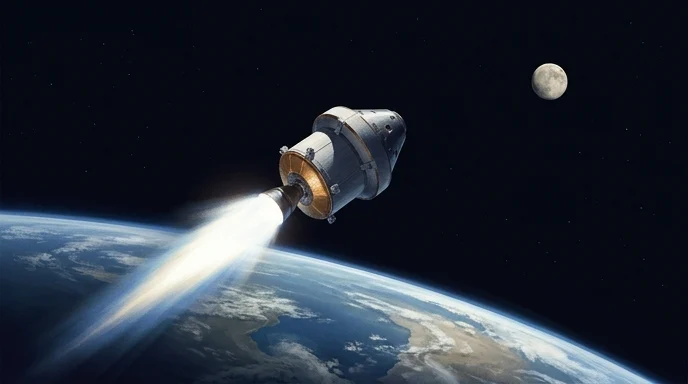
The world is following every stage of the journey. And now as the Artemis mission leaves Earth's orbit, the Moon is getting closer again. The success of the key ignition of the main engine of the Orion spacecraft was confirmed. The translunar injection maneuver lasted six minutes.
Upon release from Earth's orbit, they began the exit trajectory toward Earth's closest neighbor. «Today, for the first time since Apollo 17 in 1972, humans have left Earth's orbit. It is now on a precise trajectory towards the Moon. Orion operates with a crew for the first time in space. “We are collecting crucial data and learning from every step.” This was stated by administrator Lori Glaze, at NASA headquarters in Washington. «We have eight days of intense work ahead of us. But this is a transcendental moment and we are proud to share it with the world," he points out.

Impulse to the Moon
NASA's SLS (Space Launch System) rocket and Orion spacecraft lifted off from launch pad 39B at the Kennedy Space Center. The four astronauts make a planned ten-day test flight around the Moon and back.
After reaching space, Orion deployed its four solar panels. This allowed the spacecraft to receive power from the Sun. The transition of the spacecraft from launch to flight operations began. A scheduled boost pushed Orion into a high Earth orbit about 74,000 kilometers above Earth. It would be done for about 24 hours to perform system checks.
There are other tasks completed so far. For example, crew acclimatization to the space environment. Also carrying out their first rest periods and starting the first flywheel exercise.
Photographs
During a lunar flyby scheduled for Monday, April 6, astronauts will take high-resolution photographs. They will share their own observations of the lunar surface. They will include areas of the far side of the Moon never before seen directly by humans.
The far side of the Moon will be partially illuminated during the flyby. But favorable conditions will generate shadows that will spread across the surface. They will enhance the relief by revealing depths, ridges, slopes and crater rims that are often difficult to detect in full illumination. After a successful lunar flyby, the astronauts will return to Earth and land in the Pacific Ocean, off the coast of San Diego. Now that Artemis leaves Earth's orbit, the space future is getting closer.
Leave a Reply