

When filing income tax returns, many investors wonder whether or not they should include their assets, especially when it comes to non-traditional investments such as cryptocurrencies.
The Treasury has taken this type of investment into account for a few years, which is why the requirements and obligations change almost from campaign to campaign.
This year, a specific section is introduced in the draft Income Tax to declare cryptocurrencies, which makes a process that until now could be a bit confusing easier. In this article you will learn everything you need to know to declare your cryptocurrencies in your Income Tax Return.
Keys to include your cryptocurrencies in the Income Tax Return
If you have questions about how to declare your cryptocurrencies in the Personal Income Tax Return and whether you are obliged to do so or not, here are all the details:
When should you declare your cryptocurrencies
If during the previous year you have bought and sold cryptocurrencies, you are obliged to declare them in your Income Tax. This is mandatory without there being a minimum amount for it, even if it was only one euro.
It also does not matter if you have made profits or if luck has not been on your side and you have recorded capital losses. In any case, you have to declare your cryptocurrencies.
You also have to report to the Tax Agency if you have exchanged some cryptocurrencies for others or have obtained currency through mining. In this case, in which you have used computer equipment to generate cryptocurrencies, you must be registered with the Economic Activities Tax (IAE) and declare it as income from this activity, which is currently exempt from VAT.
In the same way, you must declare your cryptocurrencies if you have them abroad or if you have obtained them through staking, which provides passive returns for having cryptocurrencies stored in certain exchanges under specific conditions. If this is your case, you must declare these gains as if they were capital gains.
The only case in which you don't have to declare your cryptocurrencies It is if you have only bought but have not sold or exchanged them for others, which is known as HODL.
How to declare your cryptocurrencies in your income tax
This year the Treasury has included a section to declare cryptocurrency gains or losses that covers boxes 1800-1814. These boxes are accessed by selecting the “Equity gains and losses” section and then “Virtual currencies”. Once in this section, basically what you have to do is declare each and every one of the operations you have made with cryptocurrencies.
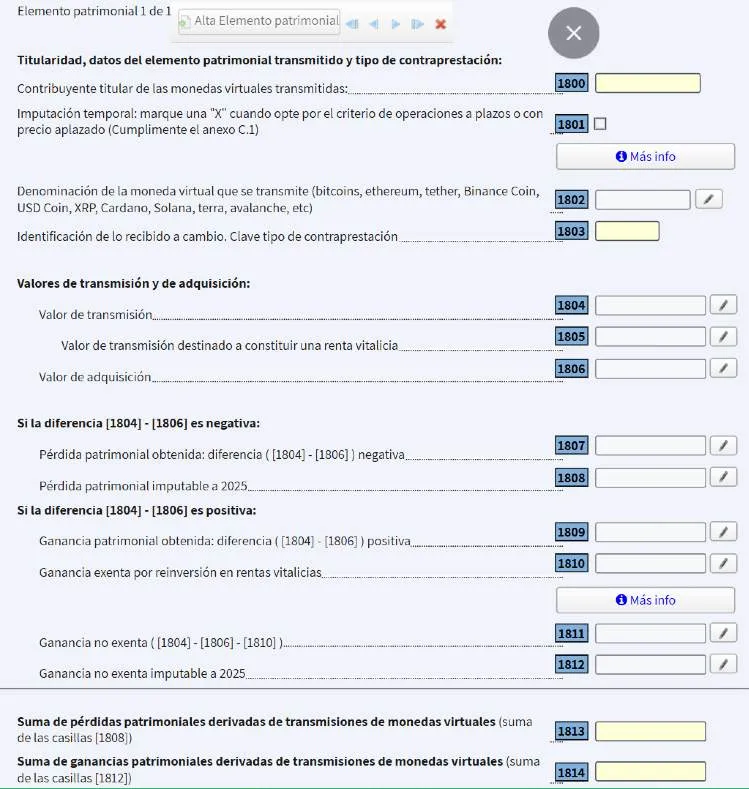
For this it must be indicated, clicking on the pencil next to the boxes:
-The denomination of the crypto with which the transaction has been carried out (Bitcoin, Ethereum, XRP…)
-Type of consideration: F for sales of cryptocurrencies for fiat money (euros, for example), N for exchange for another crypto, O for exchanges for other digital goods such as NFTs and B for the purchase of goods or services with cryptocurrencies.
-Acquisition value of the cryptocurrencies (the price at which it was purchased).
-Transmission value (the price at which it was sold).

Every time you want to enter a new operation, You must click on the “Register heritage element” button. The rest of the sections can be left as they are in 99% of the cases. With this information, the draft will calculate the capital gains or losses and with this we will be able to know how much we should pay for our cryptocurrencies.
How much will you pay when declaring your cryptocurrencies
The amount to be paid for capital gains is in stages:
-19% for the first 6,000 euros.
-21% from 6,000 to 50,000 euros.
-23% from 50,000 to 200,000 euros.
-27% from 200,000 to 300,000 euros.
-30% for more than 300,000 euros.
Remember that this is only about the profits, not the total invested. That is, if you have lost money, you will not have to pay anything (although you are obliged to declare the losses).
Do exchanges report to the Treasury?
Exchanges that operate in Spain are obliged to “snitch” to the Treasury about their users' cryptocurrencies. For this purpose, companies must present two models; 172, in which they will report the total balances of the clients, and 173, in which they will detail the operations carried out by them.
When a message appears when starting the Income draft indicating that the entity is aware of the declarant's possession of cryptocurrencies, it is due to these models. Still, there is no need to be alarmed. This message is not a sanction, just a friendly warning that we should not forget to declare all our assets.
But not only the exchanges have the obligation to inform the Treasury, but also the user. This is done with model 721, which is a merely informative model. This form must be filled out when you have more than 50,000 euros in cryptocurrencies abroad. The nuance is that this amount must be guarded by a third party (generally, an exchange) since when we are the ones who own the cryptographic keys (as in the case of some cold wallets) It will not be necessary to present this model.
Leave a Reply