
Space debris falls to Earth faster when sunspots reach maximum activity. Experts at the Vikram Sarabhai Space Center in India discovered it. The discovery may help prevent collisions with satellites. The study is collected in 'Frontiers in Astronomy and Space Sciences'. Space debris is accelerated by the Sun.
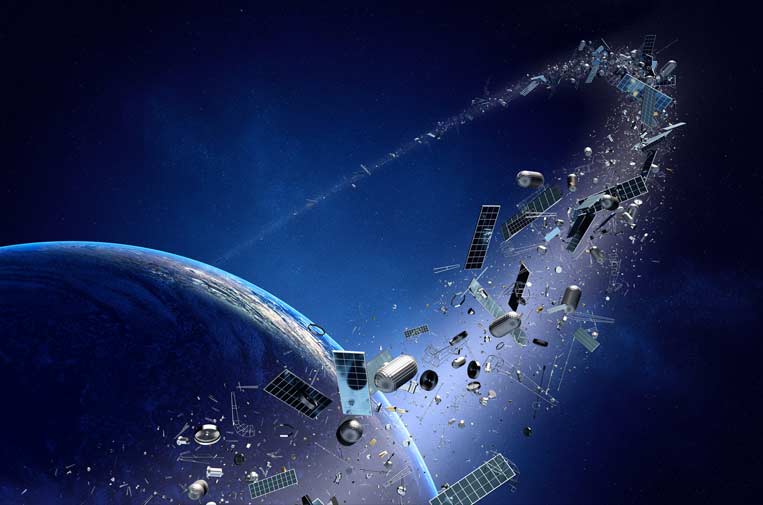
A low Earth orbit (LEO), between 400 and 2,000 km altitude, is ideal for imaging and surveillance satellites. But today it is also full of space junk. There are remains of ancient satellites and rocket stages. And they represent a threat to new space launches.
Faster descent
Even a single collision can cause chain damage. Missions to capture space debris with robots are still in their infancy. That's why scientists are currently focusing on tracking debris more precisely. It was observed that once solar activity exceeds a certain level, the loss of altitude accelerates. The Sun has an 11-year cycle of active and calm phases. They are correlated with the number of sunspots. This produces changes in the intensity with which it emits.
The historical trajectory of 17 space debris objects in low Earth orbit was followed. It was during a period of 36 years starting in the 1960s, between solar cycles 22 and 24. These objects orbit the Earth every 90 to 120 minutes at an altitude of between 600 and 800 km. They have not yet reentered the atmosphere, where they will eventually disintegrate.
Space debris does not perform active position-keeping maneuvers like satellites. So changes in the speed of its descent ('orbital decay') only depend on fluctuations in the density of the thermosphere. "Space debris shows the long-term effect of solar activity on atmospheric resistance," they indicate.

Satellites too
The trajectories were linked to long-term data on sunspot numbers. Also with daily changes in radio and extreme ultraviolet (EUV) emissions from the Sun. The results showed it. What happens when the number of sunspots exceeds two-thirds of its maximum? That space debris crosses a "transition boundary." It is a threshold beyond which it begins to fall much faster.
When solar activity exceeds certain levels, satellites (like space debris) lose altitude more quickly. This requires further orbital corrections. Not only space debris is accelerated by the Sun. The most interesting thing is that all this information comes from objects launched in the 1960s. They still contribute to science. They are valuable tools for studying the long-term effects of solar activity on the thermosphere.
Leave a Reply