
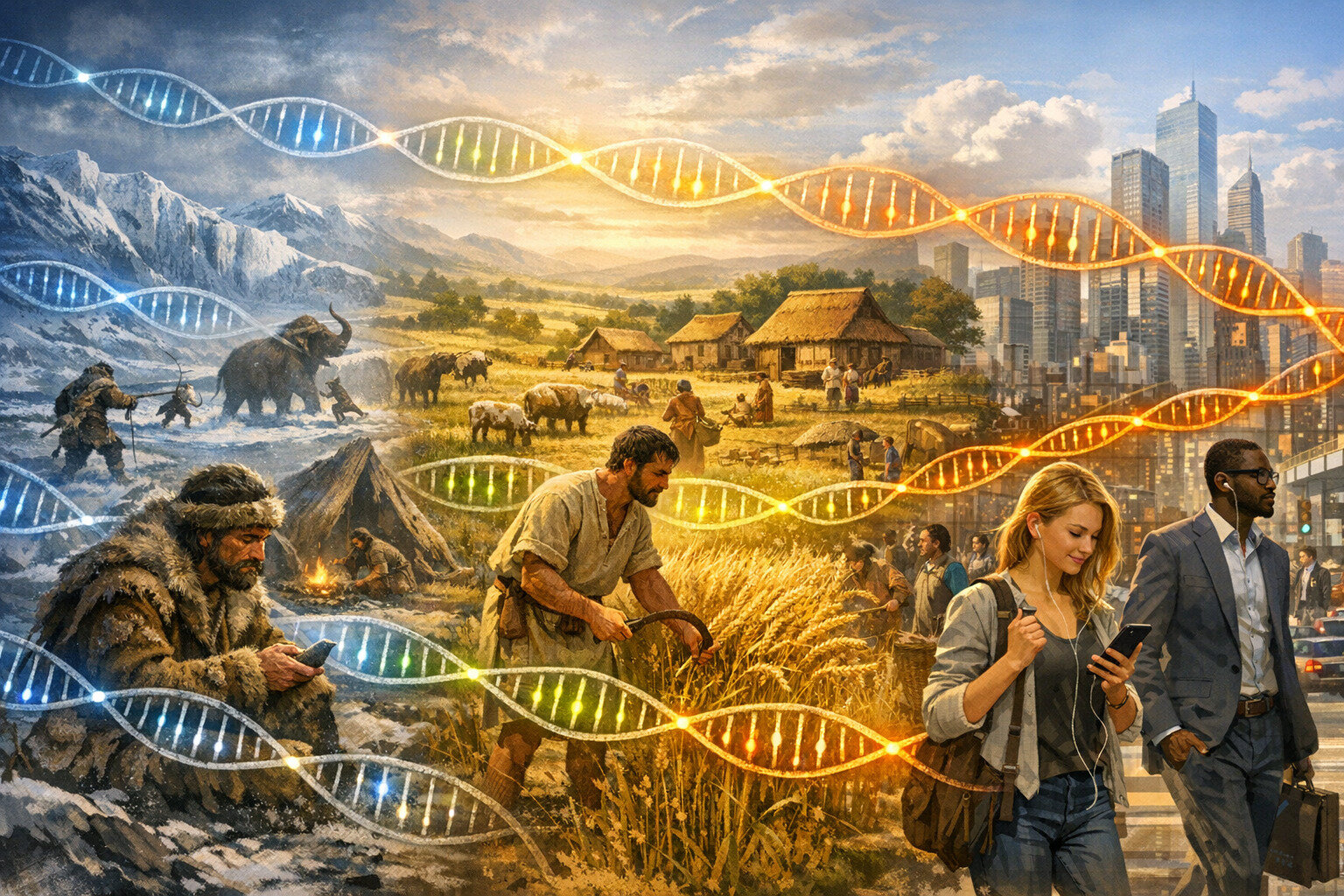
A massive study of ancient DNA from almost 16,000 people was done to prove it. They did it for more than 10,000 years in Western Eurasia. It reveals that natural selection has shaped modern human genomes much more than previously thought. This is what researchers from Harvard University say in the journal 'Nature'. The acceleration of human natural selection is recent and massive.
Understanding diseases
Until now, studies of ancient human DNA had identified only about 21 cases of directional selection. This is when a version of a gene that confers an extreme form of a trait, such as lactose tolerance, is advantageous enough for survival to be passed on to more offspring. The less advantageous versions of the gene disappear in a population. The paucity of evidence suggested that directional selection had been rare since modern humans emerged in Africa about 300,000 years ago. It was when they began to divide into different population groups around the world.
Directional selection was proven to drive the spread or decline of hundreds of genetic variants in western Eurasia since the end of the Ice Age. This has accelerated since humans switched from hunting and gathering to agriculture. The power of ancient DNA research to elucidate human genetic adaptation is demonstrated.
Many of the genetic variants identified have known links to complex physical, psychological and social traits. They include the risk of type 2 diabetes and schizophrenia. Going deeper into the evolution of these traits would better explain certain diseases. «There are new techniques and a lot of old genomic data. “We can observe how natural selection shaped biology in real time,” they say at Harvard. «It is better than looking for the traces that natural selection leaves in current genomes. Let the data speak for itself.

Inherited genetic traits
479 genetic versions, or alleles, were identified. They were strongly selected for or against in Western Eurasian genomes. They calculated when and where some of the alleles began to spread or disappear from the gene pool. Selection accelerated after the introduction of agriculture. It reflects how different traits became advantageous as people adapted to agricultural environments and behaviors. The acceleration of human natural selection forged fundamental traits in diverse human groups. Even when those groups separated and migrated to different parts of the world.
Leave a Reply