
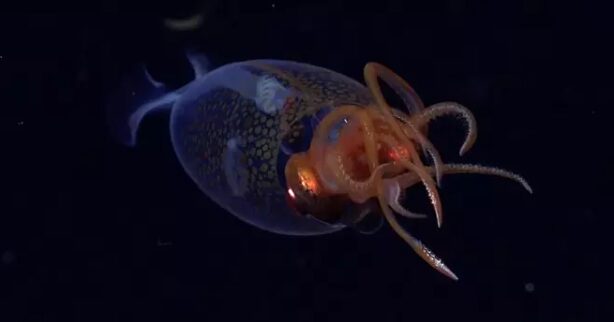
From time to time, science manages to capture new species on video. In this case, it is a species already described a century ago. But he had never seen him as now. That is why we have the first images of the Colossal squid. And they are surprising.
The Schmidt Ocean Institute was in charge of spreading the first lively confirmed observation of the Colossal squid. His scientific name is Mesonychoteuthis Hamiltoni. The images show it in depth, in their natural habitat.

Elusive
A camera aboard a robotic submersible filmed a young copy of this cephalopod about 600 meters deep. The location is near the South Sandwich Islands, in the South Atlantic. It happened during a decrease in the water column in an immersion with the aim of discovering new marine species. The project was carried out in collaboration with Ocean Census.
Mesonyteuthis Hamiltoni was formally described and appointed 100 years ago, in 1925. It was made from two partial specimens found in the stomach of a sperm whale near the South Shetland Islands. However, until now, no one had captured images of a living colossal squid.
Sea birds, marine mammals and fish feed on youth colossal squid. In its full size, its only known predators are the sperm whales and sleeping sharks. Although remains of large adults have also been found in black hake stomachs, probably scavenging.
https://www.youtube.com/watch?v=lzpog9h8hlo
Characteristics
Experts believe that colossal squid can reach total lengths of 6 to 7 meters. And it could weigh more than 500 kilograms, which makes it the heaviest invertebrate known.
The first images of the Colossal squid allow us to enter their mysterious life. Little is known about the life cycle of the species. These animals, over time, lose the transparency of youth. Fishermen have previously filmed Moorbound adults, but they have never been seen in depth, according to a statement from Schmidt Ocean.
Leave a Reply