
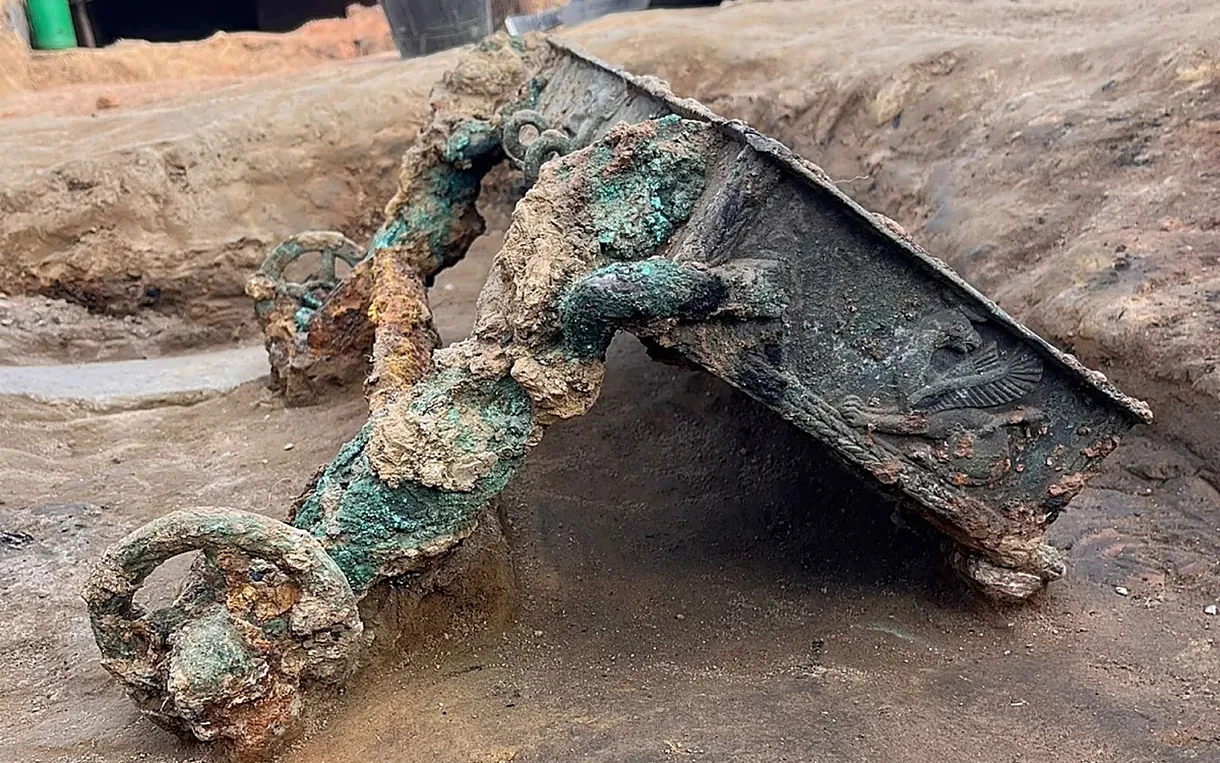
It appeared in Casas del Turuñuelo (Guareña, Badajoz). It is a find of extraordinary value. It is a bronze votive chariot dedicated to a divinity, from approximately 2,500 years ago. The piece is considered unique in the Iberian Peninsula. It has no parallels known to date in terms of its decorative and iconographic complexity. The magnificent ancient bronze chariot is a true gem.
The only examples similar to the discovered chariot have been found in ancient Etruria, in Italy. The piece seems to come from there. The treasure has appeared during the work carried out in the southern sector of the main building of Turuñuelo. It was a ritual space where an altar in the shape of a bull skin had already been rescued.
Divinity
The discovery corresponds to half of a ceremonial chariot. Two wheels and part of the main box are preserved. Despite the structure being incomplete, the level of preservation "allows us to appreciate a rich decoration and a complex manufacturing technology. Uses the assembly of multiple bronze elements using iron components.
It adds to the discovery of hundreds of ceramic objects and ivory fragments from the Tartessian site of Casas del Turuñuelo. They had trade with different territories of the Mediterranean during the 5th century. Among the motifs represented, the figure of Achelous stands out, a river deity widely known in Greek and Etruscan circles. Also two griffins located at the ends of the structure, mythological beings with the head of an eagle and the body of a lion. It has two Atlantean-type male figures, in charge of holding the car box.

Unique piece
The only known similar pieces come from the Etruscan civilization. It lived its period of maximum splendor in central Italy between the 8th and 5th centuries BC. C. It reinforces the hypothesis that there were exchange networks that connected Tartessos with different territories in the Mediterranean. It could be related to ritual activities linked primarily to banquets. The discovery took place next to the so-called banquet room, a testimony to the final agape that the Turuñuelo community celebrated before closing the building.
The magnificent thousand-year-old bronze chariot was not alone. They also found ceramics from the Attica region of Greece. And there is a container of Egyptian alabaster and ivories decorated with representations of warriors and with animal and plant motifs. This main building was sealed at the end of the 5th century BC. C. Room H-100 was also excavated, a room of about 70 square meters, the largest excavated so far in the building.
Leave a Reply