
The Sun is 149.6 million km away. Its rays take about 8 minutes to reach Earth. Andromeda 2.5 million light years away. It's how long it takes for your light to arrive. It seems like a lot, but it's not like that. It is nothing compared to other bodies in space. What is the oldest light that exists? «The oldest light in the Universe comes to us from the cosmic microwave background. "It is from when the Universe was about 300,000 years old." Says Matthew Middleton, astronomer at the University of Southampton.
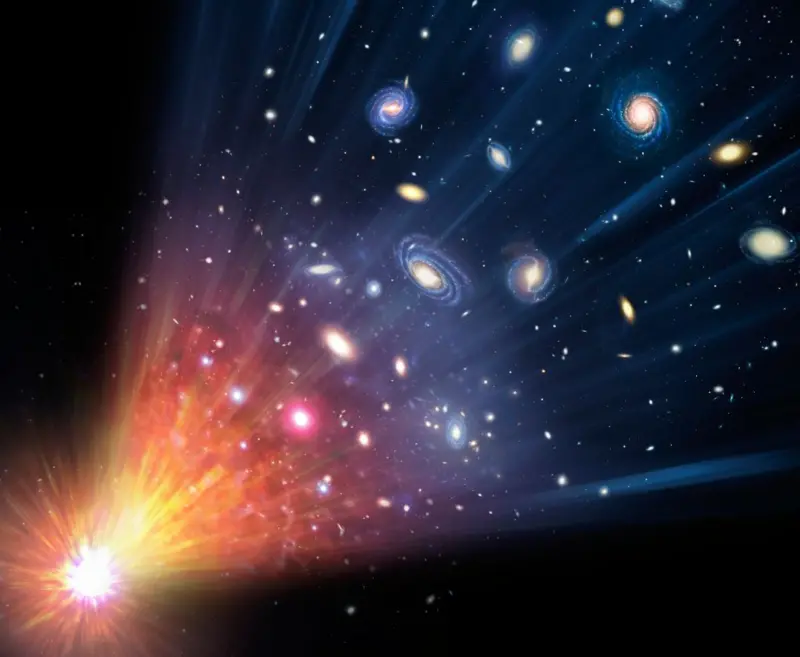
Released energy
The Universe began with the Big Bang approximately 13.8 billion years ago. At first it was an extremely hot plasma. For the first 300,000 years, photons, which are the elementary particles that make up light and all electromagnetic radiation, could not travel freely. They constantly collided with charged particles.
«But as the Universe expanded, it cooled. It was enough for protons and electrons to combine and form a hydrogen atom. "That radiation has been traveling toward us ever since." That event is called "recombination." It marked the moment when "the Universe became transparent for the first time."
It is a peak in the timeline of the Universe where a lot of energy is released. And now that energy is everywhere. "It is the fingerprint of creation." That footprint is really everywhere. If you're old enough to remember the static on old analog TVs, you've seen it. That white noise comes, in part, from the cosmic microwave background radiation that Matthew describes. It traveled through the cosmos for 13 billion years until it reached you.

infinite light
The record for the most distant and oldest star is held by JADES-GS-z14-0. Its light left when the Universe was approximately 300 million years old. It is more than 13.4 billion years old. It is the oldest light that exists. Does the light never go out? Photons are a form of energy, and that energy will always exist in some form. They may change, but the energy remains.
When a photon hits an atom, its energy can be absorbed and cause an electron to rise to a higher energy level. This is another way of looking at it: if a photon were released into the Universe and it never interacted with anything, it would forever be a photon. It never turns off suddenly. So yes, in principle, light lasts forever.
Leave a Reply