
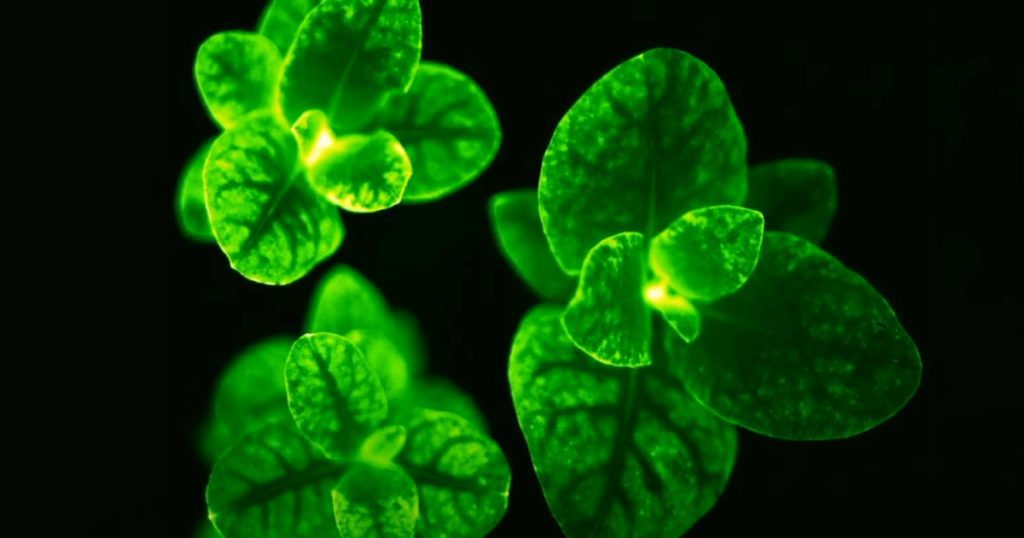
Chinese scientists have injected "luminescent" phosphorus particles to create the first plants that shine in the dark. They have blue, green, red and violet blue luminescence. The study is detailed in Matter magazine. The plants that will shine in the dark will remember the world of Avatar.
The researchers worked with succulents (plants that have horrible and fleshy tissues to store water). They managed to shine in the dark and recharge with sunlight. They were injected with light emitting compounds. Plants can shine in various colors and rival a small night light at its brightest point.

Efficient succulent
This could lay the bases for sustainable lighting systems based on plants. "Imagine the world of Avatar, where bright plants illuminate an entire ecosystem," says Shuting Liu. He is the first author of the Agricultural University of Southern China, cited by Eureka Alert. «We wanted to make that vision come true using materials with which we already work in the laboratory. Imagine brilliant trees that replace the lampposts ».
Bright vegetation is not a new idea. Previous studies have designed similar plants through genetic engineering. But the brightness is usually dim and, usually, is only available in green. They now used phosphorus particles with light effect. They are materials similar to those found in the toys that shine in the dark. These compounds absorb light and slowly release it over time.
They injected particles into several species of plants, including succulent. Only these produced an intense brightness, thanks to the narrow, uniform and uniformly distributed channels inside the sheet. They disperse the particles with greater effectiveness.

Low costs
The plants that will shine in the dark do not cost much. «Prepare each plant takes about 10 minutes. It costs a little more than 10 yuan (about 1.4 dollars), not including labor, ”they indicate. The bright succulent light fades over time. The team is still studying long -term safety of plants. It would be a sustainable alternative for low intensity lighting on roads, gardens or interior decoration. The team is also exploring how the method can illuminate other plants beyond succulents.
"It seems incredible that a micro -escala material, totally artificial, can be integrated so fluently with the natural structure of a plant," says Liu. «The way they are integrated is almost magical. Creates special functionality ».
Leave a Reply