
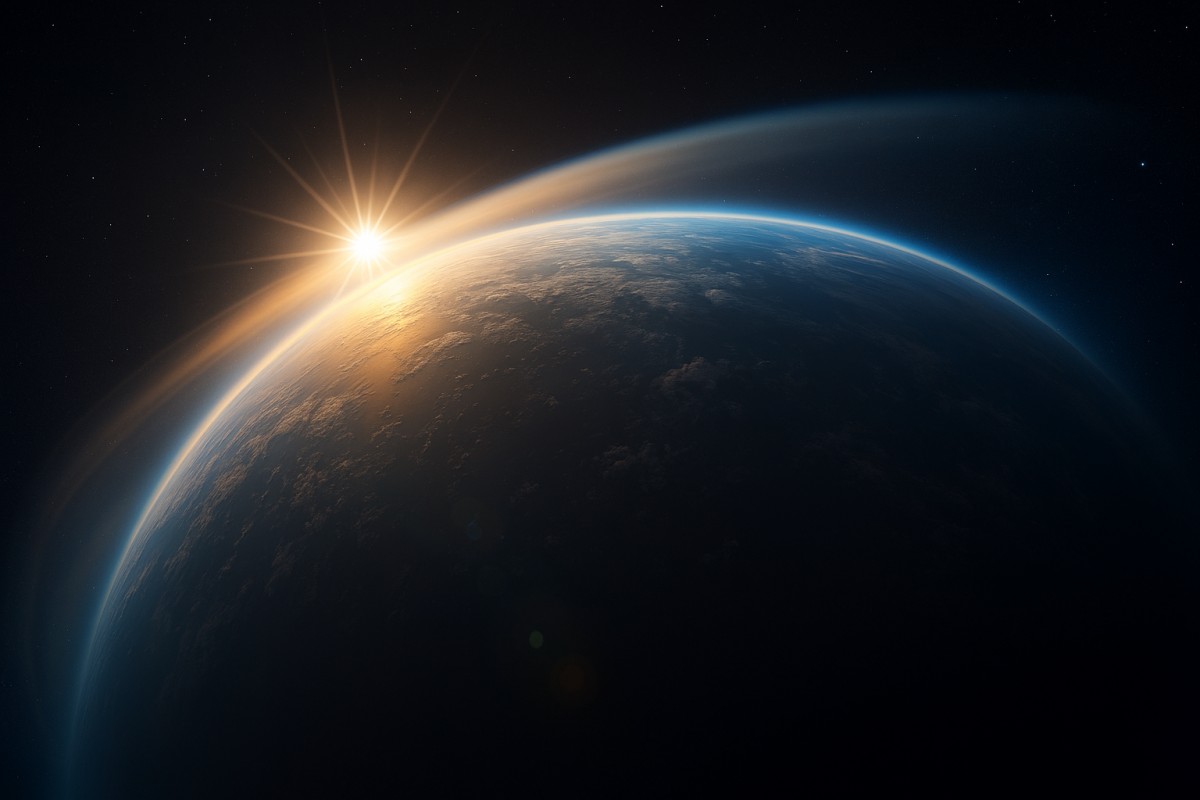
It will look for a new NASA mission. They intend to capture images of the Invisible Halo of the Earth, the dim light that emits the exosphere. It is the outermost atmospheric layer on our planet. Understanding the physics physics is a key step to forecast dangerous conditions in the near space. It is a requirement to protect Artemis astronauts who travel through the road to the moon or on future trips to Mars.
The Geocorona Carruthers Observatory will be launched from the NASA Kennedy Space Center. In the early 1970s, scientists could only speculate on the spatial extension of the Earth's atmosphere. The mystery filed in the exosphere, the outermost layer of our atmosphere, which begins about 480 kilometers high. Theorists conceived it as a cloud of hydrogen atoms. But the exosphere is only revealed through a faint "halo" of ultraviolet light known as geocorone.
First image from the moon
The pioneer scientist and engineer Dr. George Carruthers set out to observe her. He launched an ultraviolet camera ready for a space trip without return. Apollo 16 astronauts placed the Carruthers camera in the highlands of Descartes de la Luna. Humanity had the first vision of the Earth's geocorone.
"The camera was not far enough, being on the moon, to cover the entire field of vision." Lara Waldrop, a researcher at the Carruthers Observatory said in a statement. "It was shocking that this light and spongy hydrogen cloud around the earth could spread so far from the surface." It is believed that the exosphere extends at least half of the distance that leads to the moon.
When solar eruptions reach the earth, they first impact the exosphere. That is why it is crucial to understand how it reacts, so that a consequence can be prevented on our planet.
https://www.youtube.com/watch?v=jputizjstgu
Complete image
The Carruthers spacecraft will launch four times further than the moon. It will capture a complete view of the exosphere using two ultraviolet cameras: a close field sensor and a wide field sensor.
«Understanding how this works on Earth will help us understand the exoplanets. And the speed with which their atmospheres can escape, ”they conclude. Studying the invisible land halo can help us know what to look for in other parts of the universe.
Leave a Reply