
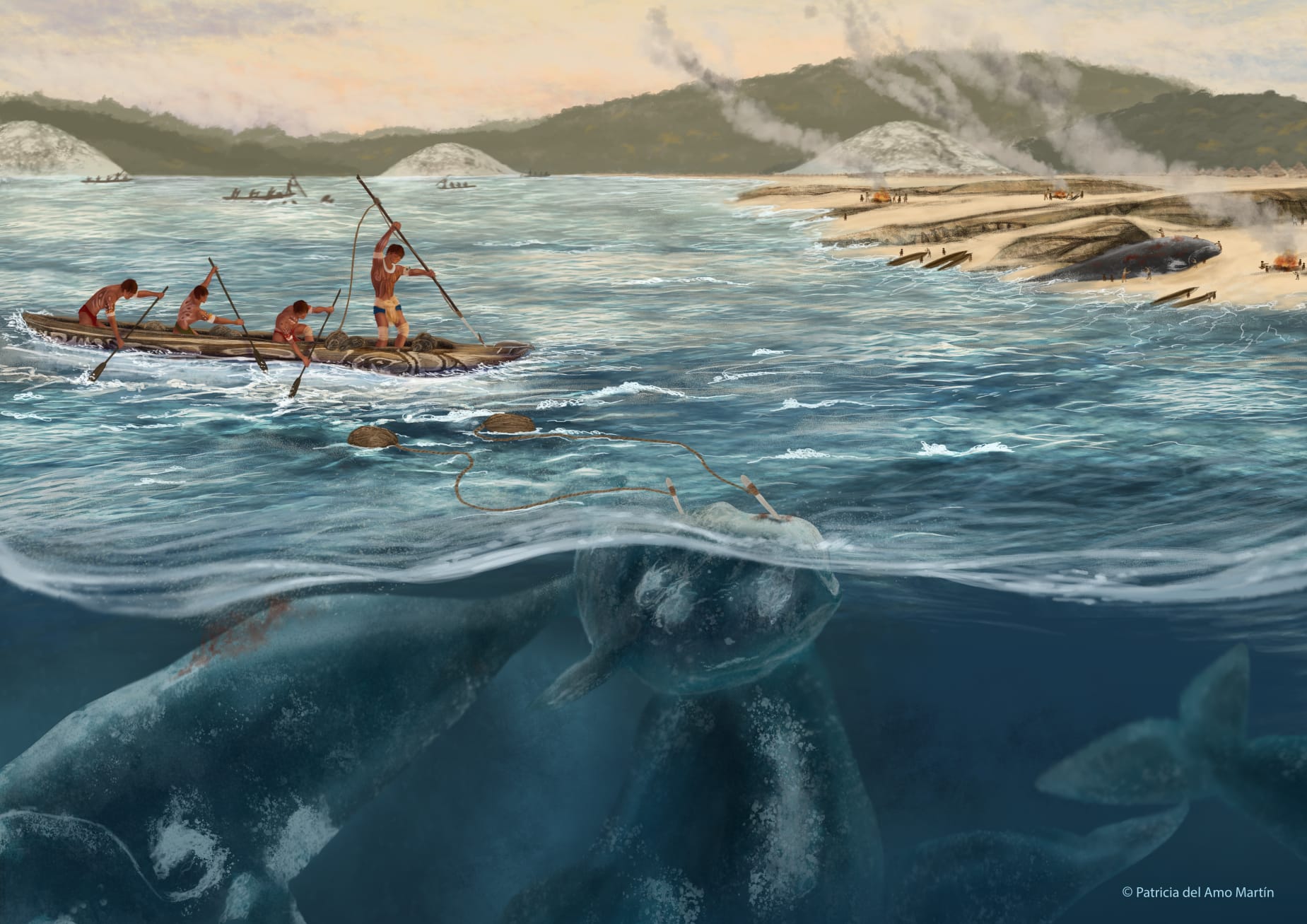
It is a thousand years older than previously believed. This was revealed by research from the Institute of Environmental Science and Technology of the Autonomous University of Barcelona (ICTA-UAB). Indigenous communities in what is now southern Brazil hunted large whales for thousands of years. Whaling is 5000 years old.
The study is in 'Nature Communications'. The people of the Babitonga Bay region did it. They developed specialized technologies for hunting large cetaceans earlier than previous archaeological research suggested.

whale hunters
The study redefines the role of South American communities in the emergence of complex maritime cultures. The origins of large whale hunting were believed to be among postglacial societies in the northern hemisphere. The estimated dates were between 3,500 and 2,500 ago.
But whaling is 5,000 years old. They analyzed hundreds of cetacean bone remains and tools made of bone. They are preserved in the Sambaquis Archaeological Museum of Joinville (Brazil). The team combined zooarchaeology, typological analysis and cutting-edge molecular techniques. They studied the bones and objects made from cetacean bone. The researchers identified remains of southern right whales, humpback whales, blue whales, sei whales, sperm whales and dolphins. Many had clear cut marks associated with their cutting. Large harpoons made from whale bone were documented, some of the largest found in South America.
This and the abundance of whale bones, their inclusion in funerary contexts and the presence of coastal species, is revealing. It provides solid evidence of active hunting and not of opportunistic use of stranded animals. The data clearly demonstrates this. These communities developed the specialized knowledge, tools, and strategies necessary to hunt large whales. And it was thousands of years earlier than supposed.
Redefining looks
The abundant presence of humpback whale remains offers clues. It suggests that its historical distribution reached areas much further south than the current main breeding areas off the coast of Brazil. «The recent increase in sightings in southern Brazil could therefore reflect a historical process of recolonization. “It has great implications for conservation,” said co-author Marta Cremer.
Researcher André Colonese stated that the study opens "a new perspective." It allows us to understand the social organization of the Sambaqui peoples and represents a paradigm shift. These groups can now be seen not only as shellfish gatherers and fishermen, but also as whalers.
Leave a Reply