
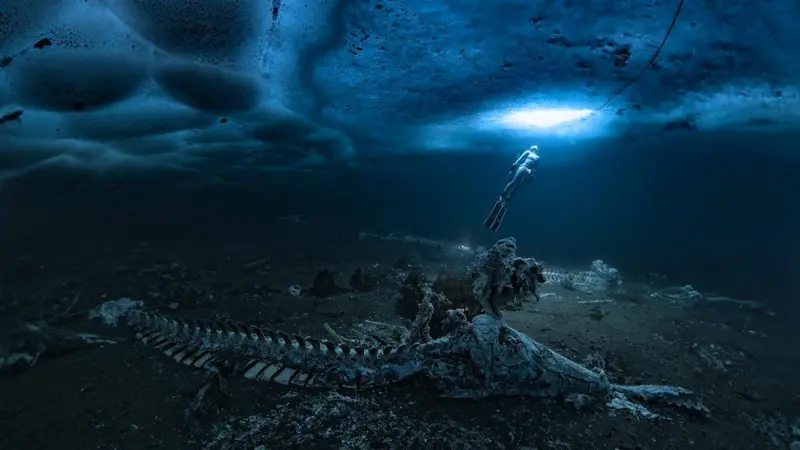
A photographer captured this extraordinary place where the bodies of whales lie in shallow waters. If they had died naturally, their bodies would be scattered across the ocean. It was in eastern Greenland. Alex Dawson entered the ocean through a hole in the sea ice. He sank into darkness and found the Whale Graveyard under the sea.
It was a mass grave of dismembered minke whales. The place he found beneath the waves was disturbing. During their lives, whales transform their environment and, when they die, they also play a fundamental role in their ecosystems. Here in eastern Greenland, bones that would have naturally fallen to the ocean floor are trapped in shallow water.
photography awards
Upon reaching the seabed, your eyes will slowly adjust to the darkness. After a while, his vision cleared. "I started looking around and thought, 'That's crazy! There are a lot of bones everywhere!' Diving under ice is one of the most dangerous types of diving. The currents could drag you under the "infinite ice," he says, "and you would disappear forever."
Sea ice is made up of fragments of frozen seawater that are compressed. They form a large mass of floating ice. "The tide was going out, which meant the ice was sinking." But he decided to take the risk. "Focus on the photography," Dawson told himself. "Everything will be fine." The decision paid off: the Swede was named winner of the 2024 Underwater Photographer of the Year award for the image he titled "Whale Bones."

whaling
Whales - some of them are the largest animals that have ever lived - often die in the open sea. Their bodies, a colossal source of nutrients, sink to the bottom of the ocean to become an oasis of life. The deepest whale carcass ever found belonged to an Antarctic minke whale. It lay in the darkness of the abyssal zone, 4,204 meters deep in the southwestern Atlantic Ocean.
Dawson photographed the underwater whale graveyard off the coast of Tasiilaq, a town of about 2,000 people. Indigenous Greenlanders continue to rely on marine resources, including permitted subsistence whaling. Families gather to skin and extract the fat and meat, leaving the corpses alone. The tide then carries the skeletons back into the water. Of this stable population, an average of nine minke whales die each year in East Greenland.
Leave a Reply